
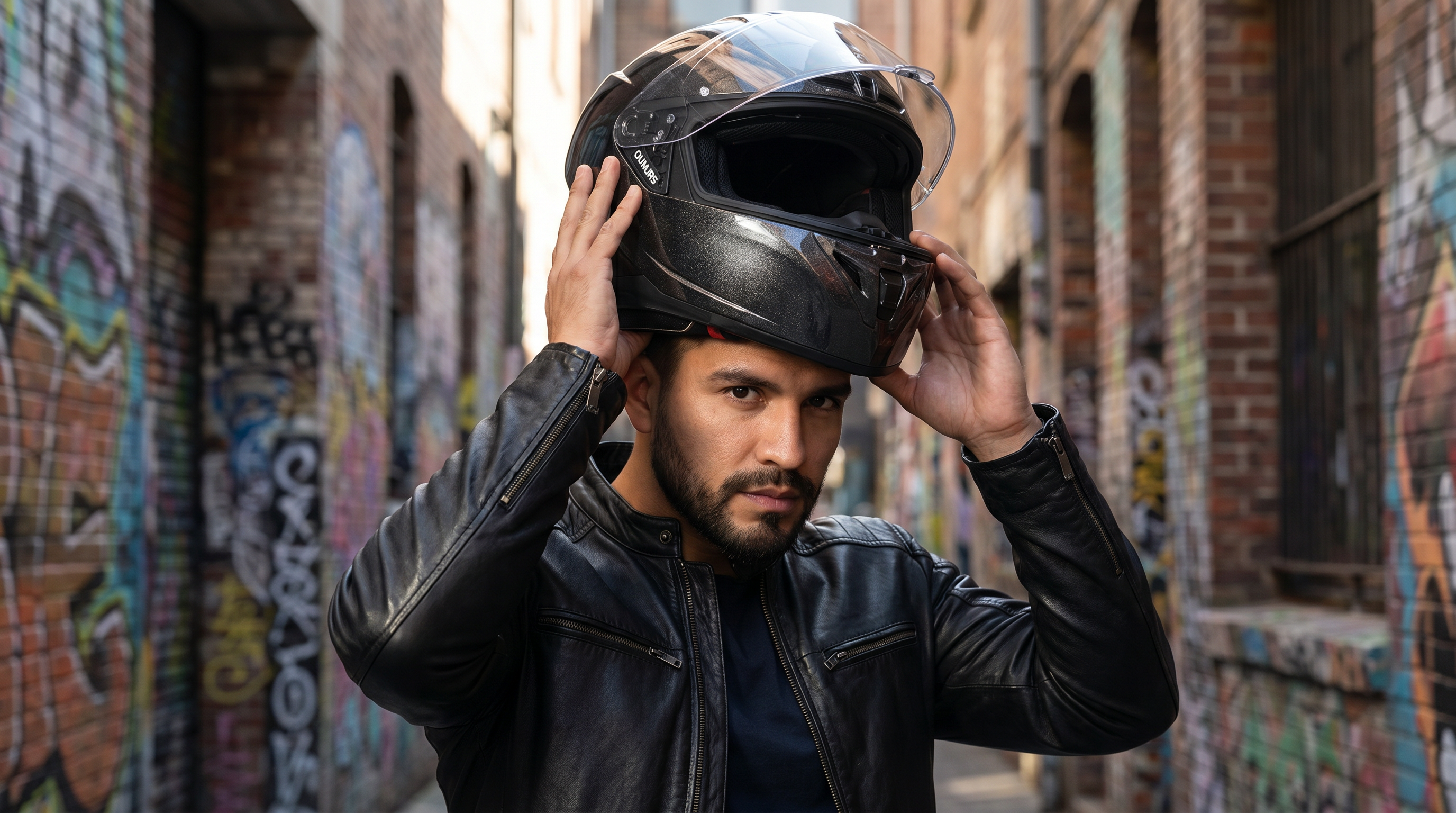
A brand-new motorcycle helmet almost always feels too tight. That snugness is by design — the interior padding compresses and conforms to your head over the first hours of wear, settling into a custom fit. But there is a fine line between a helmet that needs breaking in and one that simply does not fit. This guide explains how to break in a motorcycle helmet, how long it takes, and how to tell whether you are dealing with normal tightness or a wrong-size helmet. If you haven’t measured your head yet, start with our complete helmet fit guide.
Why New Helmets Feel Tight
Helmet manufacturers size the interior padding so that, brand new, the helmet fits a touch tighter than your final fit will be. The cheek pads and crown liner are made of comfort foam that compresses under pressure. As you wear the helmet, the foam molds to the unique shape of your head and face, easing pressure points while the protective EPS impact liner beneath stays unchanged. The result, after break-in, is a helmet that is still snug enough to stay put in a crash but comfortable for hours of riding.
A helmet that is comfortable on day one is almost certainly too big — it will only get looser, and a loose helmet is both noisy and less protective. So initial tightness is a good sign, provided it is the right kind of tightness.
How Long Does Helmet Break-In Take?
Most helmets reach a comfortable fit within 15 to 20 hours of wear, which typically means a week or two of regular riding. The cheek pads usually compress the most and the fastest, since they bear the brunt of the snugness. The crown liner conforms more gradually. By around 20 hours, the helmet should feel settled and custom-fitted. If it is still painfully tight well beyond that point, the fit or shape is likely wrong.

How to Break in a Motorcycle Helmet

1. Wear It Around the House
The simplest method is to wear the helmet while you do safe, stationary activities at home — watching TV, reading, or working at a desk. Start with 15- to 20-minute sessions a few times a day. This gently compresses the padding without the distraction of riding. Do not wear it while sleeping or doing anything where the restricted hearing and vision could be dangerous.
2. Take Short Rides First
Begin with shorter rides rather than a long tour. A 20- to 30-minute ride lets you feel how the helmet behaves in wind and with your head at riding angles, and you can stop if a pressure point flares up. Gradually lengthen your rides as the helmet eases.
3. Gently Work the Padding
You can speed the process slightly by gently massaging the cheek pads and liner with your fingers, kneading the comfort foam to soften it. Avoid aggressive pulling or stretching, which can tear the liner or stitching. The goal is gentle, repeated compression, not force.
4. Use the Helmet’s Adjustment Features
Many helmets let you swap cheek pad thicknesses. If, after break-in, the helmet is still a little loose in the cheeks, a thicker set of pads can tighten it; if a pressure point remains, thinner pads can relieve it. Check whether your helmet offers interchangeable pads — this is a cheap way to fine-tune fit without buying a new helmet.
Signs the Fit Is Right
A correctly broken-in helmet should feel:
Snug all around with even, gentle pressure and no gaps at the temples, back of the skull, or cheeks.
Secure on your head — it should not wobble side to side or shift when you turn your head.
Comfortable for an hour or more without pain, numbness, or headaches.
Free of hot spots — no single point that hurts more than the rest.
The helmet should still grip your cheeks firmly enough to slightly move your cheeks when you talk, but not so tightly that it hurts. Remember, the protective EPS liner never compresses — only the comfort padding does — so a proper break-in does not compromise safety.
Signs the Helmet Does Not Fit
Break-in cannot fix a fundamentally wrong fit. Watch for these red flags:
A sharp pressure point on the forehead that does not ease after several hours of wear usually means the helmet’s interior shape is wrong for your head (often too round or too oval).
The helmet rolls off the back of your head when you pull up on the rear — it is too large, and break-in will only make it looser.
Gaps at the temples or behind the ears indicate the helmet is too big in those areas.
Pain or numbness that persists beyond 20 hours of wear means the shape is wrong; do not keep suffering through it.
If you see these signs, return or exchange the helmet while you can. Helmets have different interior shapes — round, intermediate-oval, and long-oval — and you may simply need a different model. See our guide to helmet types to find the right style for your riding. Buying in person, or sticking with a brand whose shape you already know, is the best way to avoid this.

Does Break-In Affect Safety?
No. The impact-absorbing layer is the EPS foam beneath the comfort padding, and that layer does not compress during normal wear. Only the soft comfort liner and cheek pads compress, which affects fit and comfort but not crash protection. So you can break in your helmet without worrying that you are reducing its ability to protect you. What you are doing is making it comfortable enough that you actually want to wear it — and a helmet you wear beats one you leave at home.
Tips for a Comfortable Fit Long-Term

Keep the liner clean. Sweat and oils degrade the padding over time. Remove and wash the liner and cheek pads according to the manufacturer’s instructions to keep the fit fresh and extend the helmet’s life.
Store the helmet on its base, not resting on the visor or chin bar, to avoid deforming the padding.
Avoid hanging it on mirrors, which can dent the liner over time.
Replace the helmet every five years or after any impact, as the EPS and padding both degrade with age, sweat, and UV.
Final Thoughts
Learning how to break in a motorcycle helmet is mostly a matter of patience: wear it for short sessions, take gradual rides, and let the comfort padding compress and mold to your head over 15 to 20 hours. A properly fitted helmet ends up snug, secure, and comfortable for hours, with no pressure points or gaps. But break-in cannot fix a wrong size or shape — if the helmet rolls off, has persistent hot spots, or leaves gaps, exchange it for a model that fits your head. Start with a certified helmet — if you want dual certification, the Oumurs-361S carries both ECE 22.06 and DOT — break it in properly, and you will have head protection that is both safe and genuinely comfortable for every ride.
Shop the Oumurs 361S — ECE 22.06 & DOT Certified
Built for long-oval head shapes with interchangeable cheek pads for a fine-tuned fit. Available in three colorways:
Shop the Oumurs 361S →
Share: