
Few things ruin a ride as fast as a dead battery. You gear up, hit the starter, and get nothing but a click — or worse, a slow crank that fades to silence. Motorcycle batteries work hard in a tough environment: vibration, heat, cold, and long periods of sitting all take their toll. With a little regular motorcycle battery maintenance, you can avoid the dead-battery surprise and extend the life of this essential component. This guide covers battery types, charging, storage, and the habits that keep your battery healthy.
Why Battery Maintenance Matters
A motorcycle battery does more than start the engine. On modern bikes it also powers the fuel injection, ignition, lights, and electronics every time you turn the key, and it buffers the electrical system when demand exceeds what the charging system produces at low rpm. A weak battery causes hard starting, dim lights, erratic electronics, and can leave you stranded. Batteries also degrade faster than most riders realize — a neglected battery may last only a season or two, while a cared-for one can serve for several years. Regular maintenance is cheap insurance against a no-start and the cost of premature replacement.
Motorcycle Battery Types
Understanding your battery type determines how you care for it:
- Conventional (flooded) lead-acid: The old style, with removable caps to top up electrolyte with distilled water. They are cheap but require regular attention and can spill.
- Sealed maintenance-free (AGM/VRLA): Absorbent Glass Mat batteries are sealed, spill-proof, vibration-resistant, and hold charge well. They are the most common type on modern bikes and need no water topping.
- Lithium-ion (LiFePO4): Lightweight and powerful, popular as upgrades. They hold charge for long periods and crank hard, but they are sensitive to over-discharge and cold, and they require a lithium-specific charger. Never use a standard lead-acid charger's desulfation mode on a lithium battery.
Identify your type before charging or maintaining — using the wrong charger or method can damage the battery or be dangerous.
How to Check Your Battery
A quick monthly check catches problems early:
- Visual inspection: Look for corrosion on the terminals, a swollen or cracked case, or leaks. Clean any corrosion with a baking-soda-and-water solution and a brush, then protect the terminals with a thin coat of dielectric grease.
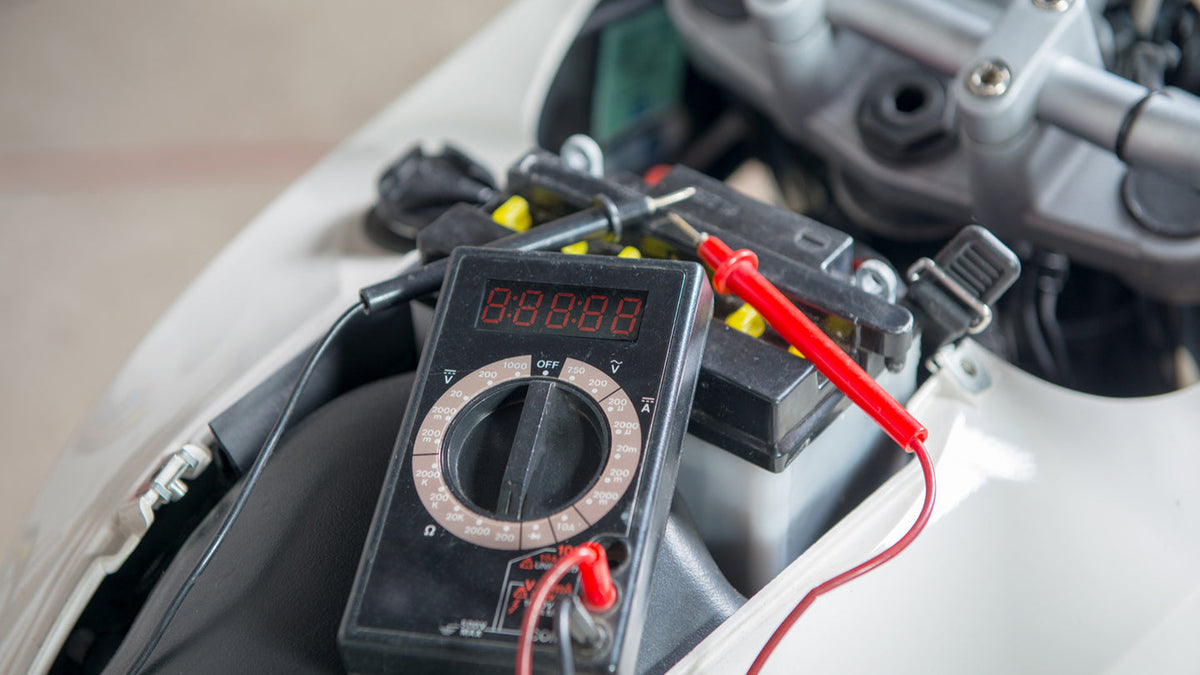
- Voltage check: With the engine off, a healthy lead-acid battery reads about 12.6 V or higher; a lithium battery around 13.2 V. Below 12.4 V (lead-acid) indicates it needs charging. Use a multimeter across the terminals.
- Terminal tightness: Ensure the connections are clean and tight — a loose terminal causes intermittent electrical faults.
- Charging system (running test): With the engine running above idle, voltage should rise to about 13.8–14.5 V, showing the stator and regulator are charging. If it does not rise, or rises too high, you have a charging-system problem, not a battery problem.
How to Charge a Motorcycle Battery
Use a smart charger designed for motorcycle batteries — ideally one with a maintenance/float mode. The best investment most riders can make is an automatic trickle charger or battery tender with an AGM/lithium-appropriate setting.
- Connect correctly: Connect the positive (red) lead to the positive terminal first, then the negative (black) to the negative terminal or a grounded frame point. Reverse when disconnecting.
- Select the right mode for your battery type and capacity. Charging a small motorcycle battery at too high a current overheats and damages it — a smart charger delivers the low, safe current these batteries need.
- Charge until full, then let the charger switch to float/maintenance mode. This keeps the battery at full charge without overcharging.
- For lithium batteries, use only a charger with a lithium-specific mode. Charging a lithium battery that has dropped below its minimum voltage may require a special recovery process, or the battery may be permanently damaged.
Never charge a frozen battery, never charge near open flame (batteries produce hydrogen gas), and never connect a car charger's high-amperage setting to a motorcycle battery.
Preventing Sulfation and Parasitic Drain
The two biggest killers of motorcycle batteries are sulfation and parasitic drain:
- Sulfation occurs when a lead-acid battery sits partially discharged. Lead sulfate crystals form on the plates and, if left, harden into a coating that reduces capacity and eventually kills the battery. The fix is simple: keep the battery fully charged. If the bike sits for more than a couple of weeks, connect it to a maintenance charger.
- Parasitic drain comes from alarms, clocks, fuel-injection memory, and accessories that draw power even with the bike off. Over weeks of sitting, these slowly drain the battery. If you store the bike, either keep it on a maintenance charger or disconnect the negative terminal.
Battery Maintenance During Storage
When laying up the bike for the off-season, proper battery care is critical:
- Remove the battery from the bike and store it in a cool, dry place — extreme heat and freezing cold both degrade it.
- Charge it fully before storage and check it monthly, topping up as needed.
- Or, better, connect it to a smart maintenance charger for the entire storage period so it stays at optimal charge.
- Never store a discharged battery — it will sulfate and may not recover.
See our motorcycle winter storage guide for the full layup routine.
Signs Your Battery Needs Replacing
Even with perfect care, batteries eventually fail. Watch for:
- Slow cranking or a clicking starter, even when charged.
- Voltage that drops quickly under load or will not hold a charge overnight.
- A swollen or cracked case.
- A battery more than three to five years old (lead-acid) that is showing weakness.
When replacing, choose a battery of the correct type, size, and cold-cranking amps for your bike. A cheap, underspecified battery will disappoint; a quality AGM or lithium unit from a trusted brand will serve you far better.
Final Thoughts
Motorcycle battery maintenance is mostly about keeping the battery charged and clean. Identify your battery type, check voltage and terminals monthly, use a smart charger with the correct mode, and never let the battery sit discharged. During storage, remove and maintain it or keep it on a tender. These simple habits prevent the dead-battery surprise and add years of life. Pair a healthy battery with the rest of your maintenance schedule — fresh oil, good tires, and sharp brakes — and your motorcycle will start reliably and run its best every time you turn the key.
Related reading: How to Adjust a Motorcycle Chain: Slack, Tension, and Lubrication and How to Clean and Lubricate a Motorcycle Chain.
Share: